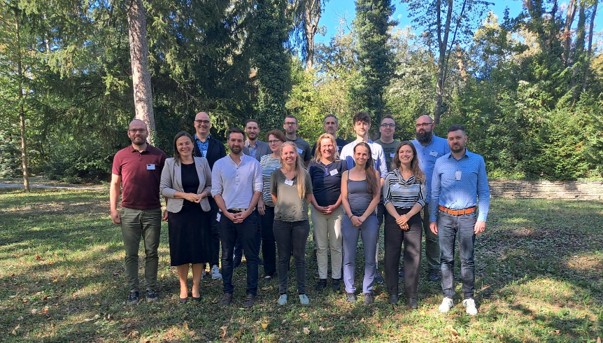
On 1 and 2 October 2026, the first joint meeting of the ForBioSink project partners took place in Vienna. Partner institutions from Austria, Czechia, Slovenia, and Serbia participated in the meeting. During the meeting, the progress of the project to date was reviewed, and the coordination of common methodological approaches and planning of upcoming project activities were discussed.
A substantial part of the programme was dedicated to Work Package 1, coordinated by CzechGlobe, which focuses on the relationships between biodiversity, forest structure, productivity, and carbon storage. The meeting included a presentation of the harmonization approach for National Forest
Inventory data from the participating countries, as well as the methodology for calculating biomass and carbon stocks in living trees and deadwood, together with indicators of species and structural diversity.
The presentation also included the first results from the processing of Czech National Forest Inventory data. Selected indicators of biodiversity, forest structure, and carbon stocks were visualized on maps, allowing their spatial distribution to be examined and areas with different combinations of these indicators to be compared. The Czech dataset and the developed methodological approach now serve as a basis for harmonizing similar calculations in the other partner countries.
Another presentation by the CzechGlobe team introduced an activity within Work Package 4, focusing on the use of modern near-real-time forest monitoring and the pathway from measured data to decision support. The presentation showed how continuous monitoring of tree growth, tree water relations, and microclimatic conditions can be linked with the assessment of current forest conditions and forest responses to rapidly changing environmental conditions.
Within the other work packages, partners also discussed the preparation of national forums linking science and practice. Colleagues from the Institute of Lowland Forestry and Environment at the University of Novi Sad presented a proposed methodology for these forums and carried out a pilot simulation. The aim is to involve relevant stakeholders in the preparation of the Action Plan and national recommendations for forest management.
Participants also discussed communication of project results, preparation of educational activities, and ways to adapt scientific knowledge to different target groups. The meeting concluded with a summary of the main outcomes and an agreement on the next steps and responsibilities of the individual teams.
The ForBioSink – Biodiversity-Rich Forests for Natural Carbon Sequestration project is implemented within the European Climate Initiative (EUKI) programme and brings together partners from Austria, Czechia, Slovenia, and Serbia.