Provider: HORIZON EUROPE
Another participant in the project: Ústav výzkumu globální změny AV ČR, v. v. i.
Keywords: ecosystem condition, biodiversity, ecosystem services, policy making, transdisciplinary, sustainability
Annotation of project:
The importance of biodiversity (BD) and healthy ecosystems and the services they deliver has increasingly been acknowledged. Policy initiatives, such as the EU BD Strategies 2020 and 2030, IPBES, IPCC and CBD were launched to address BD, natural capital and related values. Research has created a knowledge base to better understand nature-human interactions that are at the base of ecosystem services (ES) delivery. The key aim of related actions is to provide robust information that can be harnessed to support protection, restoration and sustainable as well as climate-neutral use of ecosystems in the EU by 2030. MAES has provided the conceptual, methodological and data base for comprehensive assessments on different spatial scales, including the EU-wide assessment (2020)
and assessments in EU member states. Knowledge and data for different ecosystem types (including protected and marine areas) are increasingly available. The next step is to integrate the different MAES components (ecosystem mapping, condition, ES, accounting) and to enable the uptake of ES in decision making. Key challenges include the proof of BD-ecosystem condition-ES relationships and
to link them to EU policies. The consortium brings together experts from all EU member states, associated countries and EU overseas regions with stakeholders from various public and private sectors. The expertise in the consortium includes leading experts (ecologists, economists, social scientists) on ES science, ecosystem accounting and on science-policy-business interfaces from related actions (OpenNESS, ESMERALDA, MAIA, MAES, ESP, IPBES, BD Partnership). Therefore, the project will successfully address the call's challenges and provide applicable tools and models together with guidance how to use them. The project will deliver real cases for an evidence-, ES-based and harmonised decision making across Europe, enabling transformative change to halt BD decline and to secure essential ES-sustainable supply and use.

Click for the search
Number of projects found: 314
Transformative pathways for synergising just biodiversity and climate actions
Provider: HORIZON EUROPE
Another participant in the project: Ústav výzkumu globální změny AV ČR, v. v. i.
Keywords: Biodiversity, climate, transformative change, leverage points, levers, tipping interventions, social innovation, nature-based solutions, dialogue, planetary boundaries, justice, integrated assessment
Annotation of project:
The global biodiversity and climate crises cannot be solved in isolation or by merely ramping up what is already being done. Urgent and ambitious transformative changes are needed in our economies and societies. Through inclusive deliberation TRANSPATH identifies leverage points and interventions for triggering transformative changes at consumer, producer and organisational levels. It seeks whole-of-society opportunities for achieving climate-neutrality whilst simultaneously allowing local communities and nature to flourish. TRANSPATH draws on diverse contexts in Eastern and Western Europe, Africa and Latin America, to engage with those who affect and are affected by trade regimes and associated ‘greening’ mechanisms. Through deliberation on alternative visions, values, actions, and their systemic interactions across scales and over time, TRANSPATH identifies leverage points that can trigger positive cascading biodiversity changes. Policy packages and other interventions are designed, to enable the emergence of leverage points at different scales of action in ways that changes the choice architecture underlying daily decisions. These interventions consider the synergies and trade-offs of actions across multiple people and places, and the role of incentives and political barriers to implementation. TRANSPATH delivers a suite of Transformative Pathways with a Toolbox of Transformative Interventions for triggering and enabling these pathways. A Transformative Navigation Toolkit guides practitioners on how to enable and navigate pathways, acknowledging that arriving at what constitutes a ‘transformative pathway' is also a product of an iterative and adaptive process that emerges and evolves over time. To implement these, TRANSPATH develops a multi-scalar network of activated agents of change, who can foster inclusive and legitimate decisions, and build capacity and willingness among their actor networks to collectively move forward on transformative pathways.
Another participant in the project: Ústav výzkumu globální změny AV ČR, v. v. i.
Keywords: Biodiversity, climate, transformative change, leverage points, levers, tipping interventions, social innovation, nature-based solutions, dialogue, planetary boundaries, justice, integrated assessment
Annotation of project:
The global biodiversity and climate crises cannot be solved in isolation or by merely ramping up what is already being done. Urgent and ambitious transformative changes are needed in our economies and societies. Through inclusive deliberation TRANSPATH identifies leverage points and interventions for triggering transformative changes at consumer, producer and organisational levels. It seeks whole-of-society opportunities for achieving climate-neutrality whilst simultaneously allowing local communities and nature to flourish. TRANSPATH draws on diverse contexts in Eastern and Western Europe, Africa and Latin America, to engage with those who affect and are affected by trade regimes and associated ‘greening’ mechanisms. Through deliberation on alternative visions, values, actions, and their systemic interactions across scales and over time, TRANSPATH identifies leverage points that can trigger positive cascading biodiversity changes. Policy packages and other interventions are designed, to enable the emergence of leverage points at different scales of action in ways that changes the choice architecture underlying daily decisions. These interventions consider the synergies and trade-offs of actions across multiple people and places, and the role of incentives and political barriers to implementation. TRANSPATH delivers a suite of Transformative Pathways with a Toolbox of Transformative Interventions for triggering and enabling these pathways. A Transformative Navigation Toolkit guides practitioners on how to enable and navigate pathways, acknowledging that arriving at what constitutes a ‘transformative pathway' is also a product of an iterative and adaptive process that emerges and evolves over time. To implement these, TRANSPATH develops a multi-scalar network of activated agents of change, who can foster inclusive and legitimate decisions, and build capacity and willingness among their actor networks to collectively move forward on transformative pathways.
Understanding Plural values, intersectionality, Leverage points, Attitudes, Norms, behaviour and social lEarning in Transformation for Biodiversity decision making
Provider: HORIZON EUROPE
Another participant in the project: Ústav výzkumu globální změny AV ČR, v. v. i.
Keywords: biodiversity loss, behaviour change, intersectionality, leverage points, transformation pathways, social learning, equity, plural values, knowledge, perception, policy prioritization, creative methods
Annotation of project:
Alarming and continued loss of biodiversity now threatens both the biosphere and human life through failures in fundamental ecosystem service delivery. System-wide transformative changes are needed, including altering paradigms, behaviour and values (IPBES, 2019). To address this, PLANET4B will provide insight into the diverse perceptions of biodiversity and its communication to understand behaviours and motivations around biodiversity prioritisation. Existing multidisciplinary behaviour theories (e.g. framing, nudging, leverage points) that could be applied for biodiversity decision-making will be explored. Factors such as gender, religion, ethnicity, race, age, culture, disability will be reviewed to understand how they can potentially impact biodiversity perception and decision making. Founded on this knowledge, a transdisciplinary framework will be developed for changing attitudes and behaviour in a generative way, which actively embraces the transformative power of plural knowledges and intersectional diversity. Relevant behaviour change (e.g. experiential games), creative and deliberative (e.g. story-telling) methods will be adapted and applied in 11 place-based and sectoral cases from 8 countries, EU and at global level to explore the applicability of these theories and methods for triggering transformative change. Having monitored the impacts of these co-creative and participatory interventions in a range of key sectors, as well as socio-cultural and environmental settings, the findings will be synthesised and scaled up to EU and global levels to serve as inputs for EU and international policies (e.g. implementation of the EU Biodiversity Strategy for 2030, post-2020 global biodiversity framework) and for businesses about how transformative change can be triggered. Target groups, sectors and institutions will be enabled with the gained knowledge and methods to initiate transformative change.
Another participant in the project: Ústav výzkumu globální změny AV ČR, v. v. i.
Keywords: biodiversity loss, behaviour change, intersectionality, leverage points, transformation pathways, social learning, equity, plural values, knowledge, perception, policy prioritization, creative methods
Annotation of project:
Alarming and continued loss of biodiversity now threatens both the biosphere and human life through failures in fundamental ecosystem service delivery. System-wide transformative changes are needed, including altering paradigms, behaviour and values (IPBES, 2019). To address this, PLANET4B will provide insight into the diverse perceptions of biodiversity and its communication to understand behaviours and motivations around biodiversity prioritisation. Existing multidisciplinary behaviour theories (e.g. framing, nudging, leverage points) that could be applied for biodiversity decision-making will be explored. Factors such as gender, religion, ethnicity, race, age, culture, disability will be reviewed to understand how they can potentially impact biodiversity perception and decision making. Founded on this knowledge, a transdisciplinary framework will be developed for changing attitudes and behaviour in a generative way, which actively embraces the transformative power of plural knowledges and intersectional diversity. Relevant behaviour change (e.g. experiential games), creative and deliberative (e.g. story-telling) methods will be adapted and applied in 11 place-based and sectoral cases from 8 countries, EU and at global level to explore the applicability of these theories and methods for triggering transformative change. Having monitored the impacts of these co-creative and participatory interventions in a range of key sectors, as well as socio-cultural and environmental settings, the findings will be synthesised and scaled up to EU and global levels to serve as inputs for EU and international policies (e.g. implementation of the EU Biodiversity Strategy for 2030, post-2020 global biodiversity framework) and for businesses about how transformative change can be triggered. Target groups, sectors and institutions will be enabled with the gained knowledge and methods to initiate transformative change.
The Biodiversity Nexus: transformative change for sustainability
Provider: HORIZON EUROPE
Another participant in the project: Ústav výzkumu globální změny AV ČR, v. v. i.
Keywords: transformative change, nexus, scenarios
Annotation of project:
BIONEXT will develop knowledge, tools, and guidance for mainstreaming biodiversity into policy making and provide concrete options on how to initiate, accelerate and upscale biodiversity relevant transformative change in society. It will deliver an innovative Nexus Modelling Framework that will integrate scenarios and pathways in a co-production process with stakeholders, while modelling interlinkages between biodiversity, water, food, energy, transport, climate, and health, and enabling simulation of the impacts of indirect and direct drivers on biodiversity. Through its database of transformative change cases, BIONEXT will involve policy- and decision-makers and allows them to explore the concept of just transformative change. Plausible futures and desirable, nature-positive visions for Europe and multiple just transition pathways will be co-created in workshops and focus groups taking place in various cities around Europe. With the involvement of diverse stakeholders, the BIONEXT Pathways App will be delivered as a novel decision support tool that allows users to explore transformational building blocks, for formulating policies and implementation pathways for the biodiversity nexus. The results will contribute to science brokerage, capacity building and networking to IPBES, EU policymakers, and civil society.
Another participant in the project: Ústav výzkumu globální změny AV ČR, v. v. i.
Keywords: transformative change, nexus, scenarios
Annotation of project:
BIONEXT will develop knowledge, tools, and guidance for mainstreaming biodiversity into policy making and provide concrete options on how to initiate, accelerate and upscale biodiversity relevant transformative change in society. It will deliver an innovative Nexus Modelling Framework that will integrate scenarios and pathways in a co-production process with stakeholders, while modelling interlinkages between biodiversity, water, food, energy, transport, climate, and health, and enabling simulation of the impacts of indirect and direct drivers on biodiversity. Through its database of transformative change cases, BIONEXT will involve policy- and decision-makers and allows them to explore the concept of just transformative change. Plausible futures and desirable, nature-positive visions for Europe and multiple just transition pathways will be co-created in workshops and focus groups taking place in various cities around Europe. With the involvement of diverse stakeholders, the BIONEXT Pathways App will be delivered as a novel decision support tool that allows users to explore transformational building blocks, for formulating policies and implementation pathways for the biodiversity nexus. The results will contribute to science brokerage, capacity building and networking to IPBES, EU policymakers, and civil society.
Food Systems Transformation in Southern Africa for One Health
Provider: HORIZON EUROPE
Another participant in the project: Ústav výzkumu globální změny AV ČR, v. v. i.
Keywords: Food Systems, Transformation, One Health, Leverage Points, Equity, Southern Africa
Annotation of project:
Food Systems Transformation in Southern Africa for One Health (FoSTA-Health) will develop ambitious and inclusive visions of, and action plans for food systems transformation for achieving positive One Health outcomes in southern Africa. The project is centered around four key transformation agendas: (1) transformations within and out of maize; (2) transformations of land use and irrigation; (3) transformations from domestic to export markets; and (4) diet diversification. In relation to each, we will work with cross-system stakeholder groups (from government, industry, farmers, non-governmental organisations, and rural communities) and draw on evidence from case study contexts in Malawi, South Africa, Tanzania and Zambia to build an understanding of the complex system dynamics that link food systems transformation to diverse animal, environmental and human health outcomes. A set of representative transformation pathways (RTPs) describing alternative plausible transformation futures, will be outlined, and novel integrated modelling tools used to collaboratively evaluate the potential these offer for delivering positive One Health outcomes. This will be combined with a mapping and analysis of leverage points of food system transformation at local/landscape, national and regional government, and supply chain scales. Action plans will be developed and capacities built for supporting action around leverage points at each of these scales. Across FoSTA-Health particular attention will be paid to equity and justice in the visioning, governing and outcomes of transformative change. Critical reflection on participation and power dynamics within the focal contexts of the project, and within the project itself, will be the basis for making recommendations and advocating for the equitable and inclusive governance of food systems transformation.
Another participant in the project: Ústav výzkumu globální změny AV ČR, v. v. i.
Keywords: Food Systems, Transformation, One Health, Leverage Points, Equity, Southern Africa
Annotation of project:
Food Systems Transformation in Southern Africa for One Health (FoSTA-Health) will develop ambitious and inclusive visions of, and action plans for food systems transformation for achieving positive One Health outcomes in southern Africa. The project is centered around four key transformation agendas: (1) transformations within and out of maize; (2) transformations of land use and irrigation; (3) transformations from domestic to export markets; and (4) diet diversification. In relation to each, we will work with cross-system stakeholder groups (from government, industry, farmers, non-governmental organisations, and rural communities) and draw on evidence from case study contexts in Malawi, South Africa, Tanzania and Zambia to build an understanding of the complex system dynamics that link food systems transformation to diverse animal, environmental and human health outcomes. A set of representative transformation pathways (RTPs) describing alternative plausible transformation futures, will be outlined, and novel integrated modelling tools used to collaboratively evaluate the potential these offer for delivering positive One Health outcomes. This will be combined with a mapping and analysis of leverage points of food system transformation at local/landscape, national and regional government, and supply chain scales. Action plans will be developed and capacities built for supporting action around leverage points at each of these scales. Across FoSTA-Health particular attention will be paid to equity and justice in the visioning, governing and outcomes of transformative change. Critical reflection on participation and power dynamics within the focal contexts of the project, and within the project itself, will be the basis for making recommendations and advocating for the equitable and inclusive governance of food systems transformation.
Social Sciences and Humanities for Climate, Energy and Transport Research Excellence
Provider: HORIZON EUROPE
Another participant in the project: Ústav výzkumu globální změny AV ČR, v. v. i.
Keywords: Transitions; Interdisciplinary; Citizen engagement; Climate; Energy; Mobility; Cities; Multi-level governance; Multistakeholder; Research and innovation; EU Green Deal; EU Horizon Europe; EU SET-Plan
Annotation of project:
The Social Sciences & Humanities for Climate, Energy aNd Transport Research Excellence (SSH CENTRE) project brings together 13 leading organisations from across the EU, including: 3 universities, 5 research institutions, 2 stakeholder network organisations, and 4 R&I and communications SMEs. Our partners bring world-leading expertise across SSH and STEM disciplines applied to climate, energy and mobility, covering neutrality, community-led initiatives, heating and cooling, circular economy and sufficiency, and digital technologies. Partners will reach 228,880+ stakeholders by leveraging their significant experience in transdisciplinarity and citizen engagement, and their networks that span academia, policymakers at various levels, the private sector, civil society and citizens. Our objectives directly address the call challenge with an aim to support cross-sectoral collaborations and empowerment of citizens and networks towards the development of socially innovative solutions for the EU’s climate transition. Issues related to Open Science, inclusivity and diversity – especially with regards Southern and Eastern Europe and different career stages – are at the heart of the project. SSH CENTRE will meet its objectives through a set of 7 carefully-designed Work Packages. Key activities involve: development of novel SSH-STEM collaborations to facilitate the delivery of the EU Green Deal; SSH knowledge brokerage to support cities and regions in transition; and the effective design of strategies for citizen engagement in EU R&I activities. Outputs include producing action-led agendas and building stakeholder synergies through regular Policy Insight events. SSH CENTRE will deliver inclusive governance arrangements and engagement approaches to generate and share best practice for SSH policy advice. Through the design of effective new strategies, the high profile SSH CENTRE will overcome fragmentation across sectors to accelerate the EU’s journey to a sustainable future.
Another participant in the project: Ústav výzkumu globální změny AV ČR, v. v. i.
Keywords: Transitions; Interdisciplinary; Citizen engagement; Climate; Energy; Mobility; Cities; Multi-level governance; Multistakeholder; Research and innovation; EU Green Deal; EU Horizon Europe; EU SET-Plan
Annotation of project:
The Social Sciences & Humanities for Climate, Energy aNd Transport Research Excellence (SSH CENTRE) project brings together 13 leading organisations from across the EU, including: 3 universities, 5 research institutions, 2 stakeholder network organisations, and 4 R&I and communications SMEs. Our partners bring world-leading expertise across SSH and STEM disciplines applied to climate, energy and mobility, covering neutrality, community-led initiatives, heating and cooling, circular economy and sufficiency, and digital technologies. Partners will reach 228,880+ stakeholders by leveraging their significant experience in transdisciplinarity and citizen engagement, and their networks that span academia, policymakers at various levels, the private sector, civil society and citizens. Our objectives directly address the call challenge with an aim to support cross-sectoral collaborations and empowerment of citizens and networks towards the development of socially innovative solutions for the EU’s climate transition. Issues related to Open Science, inclusivity and diversity – especially with regards Southern and Eastern Europe and different career stages – are at the heart of the project. SSH CENTRE will meet its objectives through a set of 7 carefully-designed Work Packages. Key activities involve: development of novel SSH-STEM collaborations to facilitate the delivery of the EU Green Deal; SSH knowledge brokerage to support cities and regions in transition; and the effective design of strategies for citizen engagement in EU R&I activities. Outputs include producing action-led agendas and building stakeholder synergies through regular Policy Insight events. SSH CENTRE will deliver inclusive governance arrangements and engagement approaches to generate and share best practice for SSH policy advice. Through the design of effective new strategies, the high profile SSH CENTRE will overcome fragmentation across sectors to accelerate the EU’s journey to a sustainable future.
AgroServ - Integrated SERVices supporting a sustainable AGROecological transition
Provider: HORIZON EUROPE
Another participant in the project: Ústav výzkumu globální změny AV ČR, v. v. i.
Keywords: Sustainable agriculture, Agroecology, Agronomy, transdisciplinary research, living labs, food security, One health animal well-being, human well-being, rural communities, climate change adaptation
Annotation of project:
Developing a resilient and sustainable agriculture system, and the agroecological transitions requires a deep understanding of agroecosystems, their interactions with the environment, and management practices. AgroServ features a large consortium of research infrastructures, most of them being on the EU roadmap, and a vast offer of services at all scales, from the molecule to the organism, to the ecosystem, to the society. AgroServ will facilitate a systemic and holistic approach to understand the threats and challenges agriculture is facing, towards the implementation of a resilient and sustainable agrifood system. We propose a transdisciplinary offer of services, integrating the actors of the agriculture system in the research process, of which the farmers are the first, thanks to a wide offer of living labs across Europe. Most of the relevant field of sciences are represented in AgroServ, from natural to social sciences. We will develop a wider catalogue of integrated and customized services, thanks to a specific approach of service pipelines designed from a gap analysis, stakeholder and user demands. A strong community building and training program for access managers and users will be implemented to facilitate multi- and transdisciplinary research with all relevant actors. Results from the research performed under AgroServ will be synthetized to be used in the scope of evidence-based policy making. Data from AgroServ will be open and compliant with FAIR practices, and made available on the long-term to the communities, and be linked with the main European initiatives, as the EOSC. Strong links will be established with existing or future programs under H2020 and Horizon Europe, such as the partnerships agroecology, living labs and research infrastructures, and agriculture of data, as well as the two CSA AE4EU and ALL-READY, and the missions soil and plant health, and waters. AgroServ will collaborate with other relevant initiative in the Pillar II to of HE.
Another participant in the project: Ústav výzkumu globální změny AV ČR, v. v. i.
Keywords: Sustainable agriculture, Agroecology, Agronomy, transdisciplinary research, living labs, food security, One health animal well-being, human well-being, rural communities, climate change adaptation
Annotation of project:
Developing a resilient and sustainable agriculture system, and the agroecological transitions requires a deep understanding of agroecosystems, their interactions with the environment, and management practices. AgroServ features a large consortium of research infrastructures, most of them being on the EU roadmap, and a vast offer of services at all scales, from the molecule to the organism, to the ecosystem, to the society. AgroServ will facilitate a systemic and holistic approach to understand the threats and challenges agriculture is facing, towards the implementation of a resilient and sustainable agrifood system. We propose a transdisciplinary offer of services, integrating the actors of the agriculture system in the research process, of which the farmers are the first, thanks to a wide offer of living labs across Europe. Most of the relevant field of sciences are represented in AgroServ, from natural to social sciences. We will develop a wider catalogue of integrated and customized services, thanks to a specific approach of service pipelines designed from a gap analysis, stakeholder and user demands. A strong community building and training program for access managers and users will be implemented to facilitate multi- and transdisciplinary research with all relevant actors. Results from the research performed under AgroServ will be synthetized to be used in the scope of evidence-based policy making. Data from AgroServ will be open and compliant with FAIR practices, and made available on the long-term to the communities, and be linked with the main European initiatives, as the EOSC. Strong links will be established with existing or future programs under H2020 and Horizon Europe, such as the partnerships agroecology, living labs and research infrastructures, and agriculture of data, as well as the two CSA AE4EU and ALL-READY, and the missions soil and plant health, and waters. AgroServ will collaborate with other relevant initiative in the Pillar II to of HE.
CLIMB-FOREST - CLImate Mitigation and Bioeconomy pathways for sustainable FORESTry
Provider: HORIZON EUROPE
Another participant in the project: Ústav výzkumu globální změny AV ČR, v. v. i.
Keywords: Management, biodiversity, ecosystem service, policy, EU
Annotation of project:
CLIMB-FOREST suggests alternative sustainable short-, mid-, and long-term pathways for the forest sector to mitigate climate change in entire Europe, considering preservation of biodiversity, ecosystem services, bioeconomy, socioeconomic factors, use of long-lived wood products, and barriers for Change. It will have long-term impact by creating attitude change in the policymaking process in the EU and influence foresters to adopt to new forest management strategies. This is accomplished through several work packages closely interrelated: We aim to 1) make a conclusive map of current forestry and management in Europe, 2) gather data and enhance process understanding of carbon uptake, sinks and other factors impacting on climate at intensively researched forest field site infrastructures, 3) quantify the bioeconomy, and customer and forest industry preferences for alternative wood products and management practices, 4) perform pan-European modelling of scenarios, and the environmental and climate impact of alternative pathways for European forestry, 5) ensure adaptation to new management strategies and forest preservation owing to intense field site visits in geographically representative locations in Europe, and 6) synthesize and disseminate the CLIMB-FOREST outcomes tailored for impact on the entire forest sector. The unique strength of the CLIMB-FOREST initiative and the potential to secure future impact, lies mainly in four crucial factors; 1) the unprecedented mapping of current forestry, management and carbon sequestration, 2) the quantification of all biogeochemical and biophysical processes in the forest, which is instrumental to the understanding of climate effects in the forest, 3) the beyond the stateof-the-art modelling that involves all socioeconomic and physical factors, and agents acting in the forest sector, and 4) the multi-actor stakeholder co-creation process generating knowledge transfer and means of change in the forestry sector.
Another participant in the project: Ústav výzkumu globální změny AV ČR, v. v. i.
Keywords: Management, biodiversity, ecosystem service, policy, EU
Annotation of project:
CLIMB-FOREST suggests alternative sustainable short-, mid-, and long-term pathways for the forest sector to mitigate climate change in entire Europe, considering preservation of biodiversity, ecosystem services, bioeconomy, socioeconomic factors, use of long-lived wood products, and barriers for Change. It will have long-term impact by creating attitude change in the policymaking process in the EU and influence foresters to adopt to new forest management strategies. This is accomplished through several work packages closely interrelated: We aim to 1) make a conclusive map of current forestry and management in Europe, 2) gather data and enhance process understanding of carbon uptake, sinks and other factors impacting on climate at intensively researched forest field site infrastructures, 3) quantify the bioeconomy, and customer and forest industry preferences for alternative wood products and management practices, 4) perform pan-European modelling of scenarios, and the environmental and climate impact of alternative pathways for European forestry, 5) ensure adaptation to new management strategies and forest preservation owing to intense field site visits in geographically representative locations in Europe, and 6) synthesize and disseminate the CLIMB-FOREST outcomes tailored for impact on the entire forest sector. The unique strength of the CLIMB-FOREST initiative and the potential to secure future impact, lies mainly in four crucial factors; 1) the unprecedented mapping of current forestry, management and carbon sequestration, 2) the quantification of all biogeochemical and biophysical processes in the forest, which is instrumental to the understanding of climate effects in the forest, 3) the beyond the stateof-the-art modelling that involves all socioeconomic and physical factors, and agents acting in the forest sector, and 4) the multi-actor stakeholder co-creation process generating knowledge transfer and means of change in the forestry sector.
Národní institut pro výzkum socioekonomických dopadů nemocí a systémových rizik
Provider: Ministerstvo školství mládeže a tělovýchovy
Coordinating recipient: Masarykova Univerzita
Another participant in the project: Univerzita Karlova v Praze
Another participant in the project: Ústav výzkumu globální změny AV ČR, v. v. i.
Keywords: xxx
Annotation of project:
xxx
Coordinating recipient: Masarykova Univerzita
Another participant in the project: Univerzita Karlova v Praze
Another participant in the project: Ústav výzkumu globální změny AV ČR, v. v. i.
Keywords: xxx
Annotation of project:
xxx
Digital platform for distributed optimization and sustainable mitigation and production capacity of optimALga microalgae
Provider: Ministerstvo průmyslu a obchodu
Recipient: Ústav výzkumu globální změny AV ČR, v. v. i.
Coordinating recipient: DataFriends s.r.o.
Keywords: xxx
Annotation of project:
xxx
Recipient: Ústav výzkumu globální změny AV ČR, v. v. i.
Coordinating recipient: DataFriends s.r.o.
Keywords: xxx
Annotation of project:
xxx
Strategie AV21

News
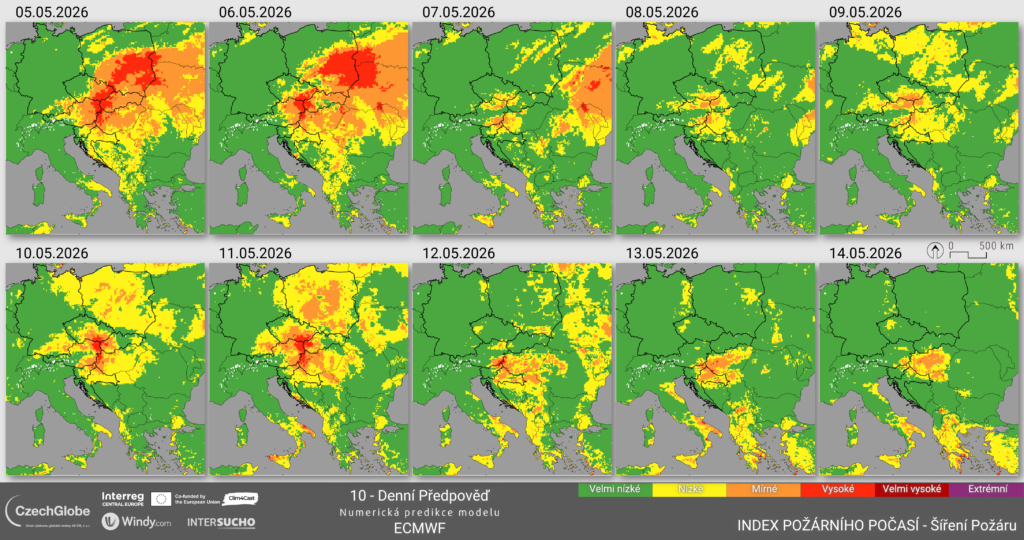
The Clim4Cast forecasting tool was presented at the EGU General Assembly 2026 in Vienna by Lukáš Dolák. The original contribution was also chosen to be presented at a press conference for journalists, along with 17 other contributions out of a total of 20,000. Within the Press conference (https://www.egu.eu/gamedia/2026/press-conferences/#PC1), the most outstanding Clim4Cast outputs were introduced, including the forecasting tool. The attending journalists appreciated both the web platform and the tool. We honestly hope that this event contributed to spreading the word not only among journalists but also to the wider public and researchers.
More 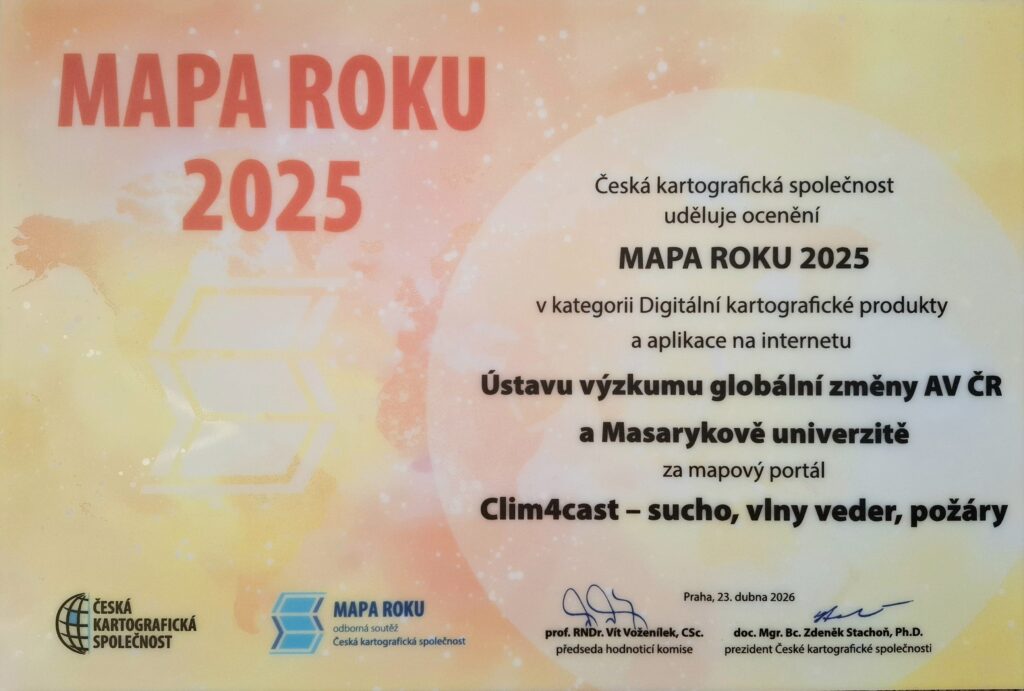
The expert jury of the Czech Cartographic Society has announced the results of the prestigious Map of the Year 2025 competition across six categories. The Clim4Cast project team, from the Global Change Research Institute CAS and Masaryk University, also participated. In the category Digital Cartographic Products and Online Applications, the team received an award among 14 competing entries for the Clim4Cast map portal – drought, heatwaves, wildfires.
More 
3 May 1943 – 1 February 2026
With deep sorrow, we announce that on 1 February 2026, Sune Linder, Emeritus Professor at the Swedish University of Agricultural Sciences in Uppsala and at the Southern Swedish Forest Research Centre in Alnarp (Sweden), passed away.
More 
ICOS Science Conference, organised every second year by the ICOS community, is a global event open to scientists and other experts working in greenhouse gases and biogeochemical cycles. ICOS Science Conference 2026 will be organised on 15-17 September 2026 in Lund, Sweden and online. The themes reflect ICOS’s three domains – Atmosphere, Ecosystem and Ocean – and incorporate broader themes such as climate services, science communication and cooperation between Research Infrastructures.
The abstract submission deadline is 6th March 2026, 15:00 CET. More here
More 
We are excited to announce that registration is now open for the 2nd International AnaEE Science Conference (ANAEESC26), the flagship biennial event of AnaEE-ERIC (Analysis and Experimentation on Ecosystems), Europe’s largest network for experimental ecology and climate change research. Taking place September 29 – October 1, 2026, at the Palais de l’Europe in Menton, France, this essential gathering brings together leading researchers and policymakers to address critical challenges facing global ecosystems through seven scientific sessions, featuring distinguished keynote speakers including Prof. Marie-Hélène Jeuffroy – INRAE, Prof. Bart Muys – KU Leuven and Dr. Nathalie Hilmi – The Scientific Centre of Monaco.
We strongly encourage you to submit abstracts for oral and poster presentations. Early career researchers can compete for our inaugural Environmental Rising Star Award, which includes up to €2000 for a research visit to an AnaEE facility abroad. The conference also features workshops on Open Science practices, policy dialogues, and valuable networking opportunities. Visit anaee.eu to register and submit your abstract.

Events / Projects / Research

We stand for Ukraine
